Biomolecular Engineering: Innovations, Applications & Future Trends
Explore biomolecular engineering, protein design, synthetic biology, molecular engineering, AI-powered biotechnology and the latest advances shaping life science research.

Discover how protein engineering, synthetic biology, computational modeling and advanced molecular technologies are transforming the way scientists design, understand and develop biological systems.
Biomolecular engineering is an interdisciplinary field that combines molecular biology, biochemistry, biotechnology, bioinformatics and engineering principles to understand, modify and design biological molecules with specific structures and functions. From engineered proteins and functional enzymes to synthetic biomolecular systems, this rapidly evolving discipline is opening new possibilities for scientific research and industrial innovation.
As computational biology and artificial intelligence become increasingly integrated into molecular research, scientists can explore complex biomolecular structures, predict molecular interactions and investigate new biological functions with greater precision.
What Is Biomolecular Engineering?
Biomolecular engineering focuses on the rational design, modification and optimization of biological molecules, including proteins, peptides, nucleic acids, enzymes and other molecular components of living systems. Its central objective is to connect molecular structure with biological function.
Unlike approaches that only observe naturally occurring molecules, biomolecular engineering uses experimental and computational strategies to investigate how molecular components can be redesigned to achieve specific characteristics. Researchers can modify amino acid sequences, study protein folding, optimize catalytic activity and explore interactions between biological molecules.
The field brings together several scientific disciplines:
- Molecular biology: Understanding DNA, RNA, genes and their regulation.
- Protein engineering: Designing and optimizing protein structure and function.
- Biochemistry: Investigating molecular reactions and biological processes.
- Computational biology: Using algorithms and simulations to analyze biological systems.
- Synthetic biology: Constructing and programming biological components and systems.
- Biotechnology: Translating molecular discoveries into practical research and industrial applications.
1. Protein Engineering: Designing Molecules with New Functions
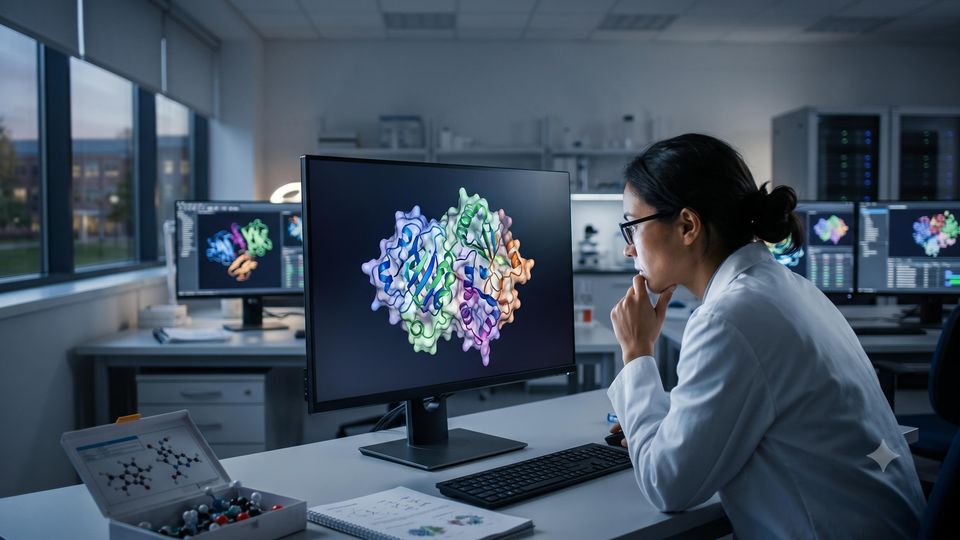
Proteins are fundamental biological molecules responsible for a wide variety of cellular and biochemical activities. Their three-dimensional structures determine how they interact with other molecules and perform their functions.
Protein engineering involves modifying existing proteins or designing entirely new protein sequences to obtain desired molecular properties. Researchers can investigate stability, binding affinity, solubility, catalytic efficiency and structural organization.
Major protein engineering approaches
Rational Protein Design
Uses structural and biochemical knowledge to introduce targeted modifications into protein sequences and investigate their functional consequences.
Directed Evolution
Uses iterative rounds of genetic variation and experimental selection to identify protein variants with improved characteristics.
De Novo Protein Design
Creates new protein sequences and structures that are not simply modifications of naturally occurring protein scaffolds.
Computational Protein Engineering
Combines molecular modeling, machine learning and structural prediction to explore and evaluate candidate protein designs.
Recent progress in generative artificial intelligence and protein structure prediction has accelerated de novo protein design. Researchers are increasingly able to explore new protein folds, molecular assemblies and binding interactions through computationally guided approaches.
2. Artificial Intelligence and the New Era of Biomolecular Design

Artificial intelligence is becoming one of the most influential tools in modern biomolecular engineering. Machine learning models can analyze large biological datasets, identify sequence patterns and support the prediction of molecular structures and interactions.
AI-assisted protein design is particularly important because protein sequences can occupy an enormous range of possible combinations. Computational models help researchers navigate this complex sequence space and prioritize candidates for experimental evaluation.
How AI supports biomolecular engineering
- Protein structure and sequence prediction.
- De novo protein generation and molecular design.
- Analysis of protein-protein interactions.
- Identification of potentially important amino acid positions.
- Prediction of protein stability and molecular properties.
- Computational screening of engineered biomolecules.
- Integration of experimental results into iterative design workflows.
However, computational predictions do not automatically establish biological activity. Laboratory validation remains essential to determine whether an engineered molecule performs as expected under real experimental conditions.
3. Synthetic Biology and the Engineering of Biological Systems
Synthetic biology applies engineering principles to the construction and modification of biological systems. It uses genetic components, regulatory sequences, proteins and cellular machinery to create programmable biological functions.
Biomolecular engineering provides many of the essential building blocks for synthetic biology. Engineered proteins, enzymes and nucleic acids can be combined to create molecular circuits and functional biological networks.
Examples of synthetic biology research
- Engineering genetic circuits with defined regulatory behavior.
- Developing synthetic cells and artificial cellular systems.
- Designing programmable molecular sensors.
- Optimizing microbial systems for biotechnology applications.
- Constructing biological pathways for specialized molecule production.
An important research direction is the integration of engineered proteins into synthetic cellular systems. These components can provide molecular recognition, structural organization, catalysis and regulatory functions.
4. Enzyme Engineering and Industrial Biotechnology
Enzymes are biological catalysts that accelerate biochemical reactions. Their ability to operate under specific environmental conditions makes them valuable tools in biotechnology, food science, industrial chemistry and environmental research.
Enzyme engineering aims to optimize properties such as catalytic activity, temperature tolerance, pH stability, substrate specificity and operational stability.
Industrial Biocatalysis
Engineered enzymes can support more selective biochemical processes in manufacturing and industrial biotechnology.
Environmental Biotechnology
Specialized enzyme systems are being investigated for biomass conversion, waste processing and plastic degradation.
Food Biotechnology
Enzyme optimization can improve processing efficiency and support specific biochemical transformations in food production.
Biochemical Research
Engineered enzymes provide valuable experimental tools for investigating metabolic pathways and molecular reactions.
5. Nucleic Acid Engineering: DNA, RNA and Molecular Innovation
DNA and RNA are central to the storage, transmission and regulation of biological information. Engineering these molecules provides researchers with ways to study gene expression, molecular regulation and biological systems.
Modern nucleic acid engineering includes DNA synthesis, sequence optimization, RNA design, plasmid construction and genetic circuit development.
Key research areas
- DNA sequence design and optimization.
- RNA structure and stability engineering.
- Plasmid and vector construction.
- Gene expression regulation.
- CRISPR-based genome engineering.
- Synthetic genetic circuits and molecular control systems.
Combining nucleic acid engineering with protein design creates opportunities to investigate complex relationships between genetic information and molecular function.
6. Biomolecular Engineering and Advanced Biomaterials
Another expanding area is the development of biomolecular materials. Researchers are exploring how proteins, peptides, DNA and other biological components can be organized into functional structures.
Protein-based materials, self-assembling peptides, DNA nanostructures and engineered molecular assemblies are examples of how biological components can be transformed into materials with specialized properties.
These approaches are being investigated in tissue engineering, biosensing, molecular fabrication, nanotechnology and advanced biomaterial research.
7. Major Applications of Biomolecular Engineering
Biomolecular engineering has applications across a wide range of scientific and industrial disciplines. Its ability to connect molecular design with biological function makes it relevant to both fundamental research and technology development.
Biotechnology
Development of engineered proteins, enzymes and molecular tools for advanced biotechnology workflows.
Structural Biology
Investigation of protein folding, molecular interactions, conformational changes and biomolecular assemblies.
Environmental Science
Engineering biological systems for bioremediation, sustainable processing and environmental applications.
Industrial Biotechnology
Optimization of enzymes and microbial systems for specialized biochemical production processes.
Molecular Detection
Design of molecular recognition components, biosensors and biological detection platforms.
Computational Biology
Integration of molecular modeling, biological datasets and AI-powered sequence analysis.
8. How Does a Biomolecular Engineering Workflow Work?
A typical biomolecular engineering project combines computational investigation with laboratory experiments. Although workflows vary depending on the research objective, many follow a similar sequence.
From Molecular Concept to Experimental Validation
- Define the research objective: Identify the target molecule and desired properties.
- Analyze molecular information: Examine sequences, structures and available biological data.
- Design the biomolecule: Develop candidate sequences or molecular modifications.
- Perform computational analysis: Evaluate structural models and predicted molecular properties.
- Generate experimental candidates: Produce or assemble selected biomolecular designs.
- Conduct laboratory validation: Assess molecular structure, activity and stability.
- Optimize the design: Use experimental findings to guide subsequent engineering cycles.
This iterative approach helps researchers connect computational predictions with measurable experimental outcomes. The combination of molecular modeling, protein characterization and biochemical assays is particularly important when developing new biomolecular systems.
9. The Future of Biomolecular Engineering: What Comes Next?
The future of biomolecular engineering will increasingly depend on the integration of artificial intelligence, high-throughput experimental technologies, advanced molecular characterization and computational biology.
Emerging directions to watch
- Generative protein design: Creating new molecular structures with tailored functions.
- Programmable protein systems: Designing molecular components that respond to specific biological signals.
- AI-guided enzyme optimization: Combining machine learning with experimental evolution.
- Multicomponent biomolecular assemblies: Engineering interactions between several molecular components.
- Synthetic cellular systems: Building increasingly sophisticated biological systems from engineered components.
- Advanced biomolecular materials: Developing self-assembling structures and functional biological materials.
- Automated laboratory workflows: Connecting computational design with high-throughput experimentation.
Despite this progress, important challenges remain. Accurate prediction of protein dynamics, molecular stability, interactions in complex environments, experimental reproducibility and scalable production continue to require significant research.
Conclusion: Engineering Biology at the Molecular Level
Biomolecular engineering is becoming a central discipline in modern biotechnology. By combining protein engineering, synthetic biology, nucleic acid design, computational modeling and biochemical research, scientists are developing new ways to understand and manipulate biological systems.
From AI-assisted protein design to engineered enzymes and advanced biomolecular materials, the field continues to expand the possibilities of molecular science. As computational and experimental technologies become more integrated, biomolecular engineering is expected to play an increasingly important role in biotechnology, industrial innovation and fundamental biological research.
Frequently Asked Questions About Biomolecular Engineering
What is biomolecular engineering?
Biomolecular engineering is the application of engineering, molecular biology and biochemical principles to design, modify and optimize biological molecules such as proteins, DNA, RNA and enzymes.
What is the difference between biomolecular engineering and protein engineering?
Protein engineering focuses specifically on designing and modifying proteins, whereas biomolecular engineering covers a broader range of biological molecules and molecular systems, including nucleic acids, enzymes and biomolecular assemblies.
How is artificial intelligence used in biomolecular engineering?
AI supports protein structure prediction, sequence analysis, de novo protein design, molecular interaction modeling and the prioritization of candidate biomolecules for experimental testing.
What are the main applications of biomolecular engineering?
Major applications include synthetic biology, enzyme engineering, industrial biotechnology, structural biology, molecular detection, biomaterial development and computational biology.
What technologies are used in biomolecular engineering research?
Common technologies include DNA synthesis, recombinant protein expression, protein purification, mass spectrometry, structural biology, molecular modeling, bioinformatics and machine learning.
Why is biomolecular engineering important for the future of biotechnology?
It enables researchers to develop biological molecules and systems with specific properties, opening new opportunities in scientific discovery, sustainable industrial processes and advanced molecular technologies.
Scientific Reading and Further Research
- The Past, Present and Future of De Novo Protein Design – Nature (2026)
- AI-Driven Protein Design – Nature Reviews Bioengineering (2025)
- Protein Design and Optimization for Synthetic Cells – Nature Reviews Bioengineering (2025)
- Protein Engineering: Status Report – Protein Engineering, Design and Selection (2026)
Explore the Science Behind Molecular Innovation
Discover the latest developments in biomolecular engineering, protein design, synthetic biology and advanced biotechnology. Continue exploring scientific research and emerging molecular technologies.
Explore Research Services